Oyuncak araba gerçek yola geçiyor
Milyonlarca izlenen reality shift trendi: pervazdaki oyuncak araba bir anda gerçek arabaya dönüşüp yola çıkıyor. Kendi aracınızla yapmanın iki yolu var. Birebir aynısı için Seedance 2.5 modeli, ücretsiz yol için Google Flow. Ben Anadol ile denedim, iki sonucu ve kullandığım prompt'ları aşağıya koydum.
İlham için Umutcan Çelikiş'e teşekkürler: @umutcancelikis. Bu bir iş birliği ya da reklam değil, kendi kullandığım yöntem.
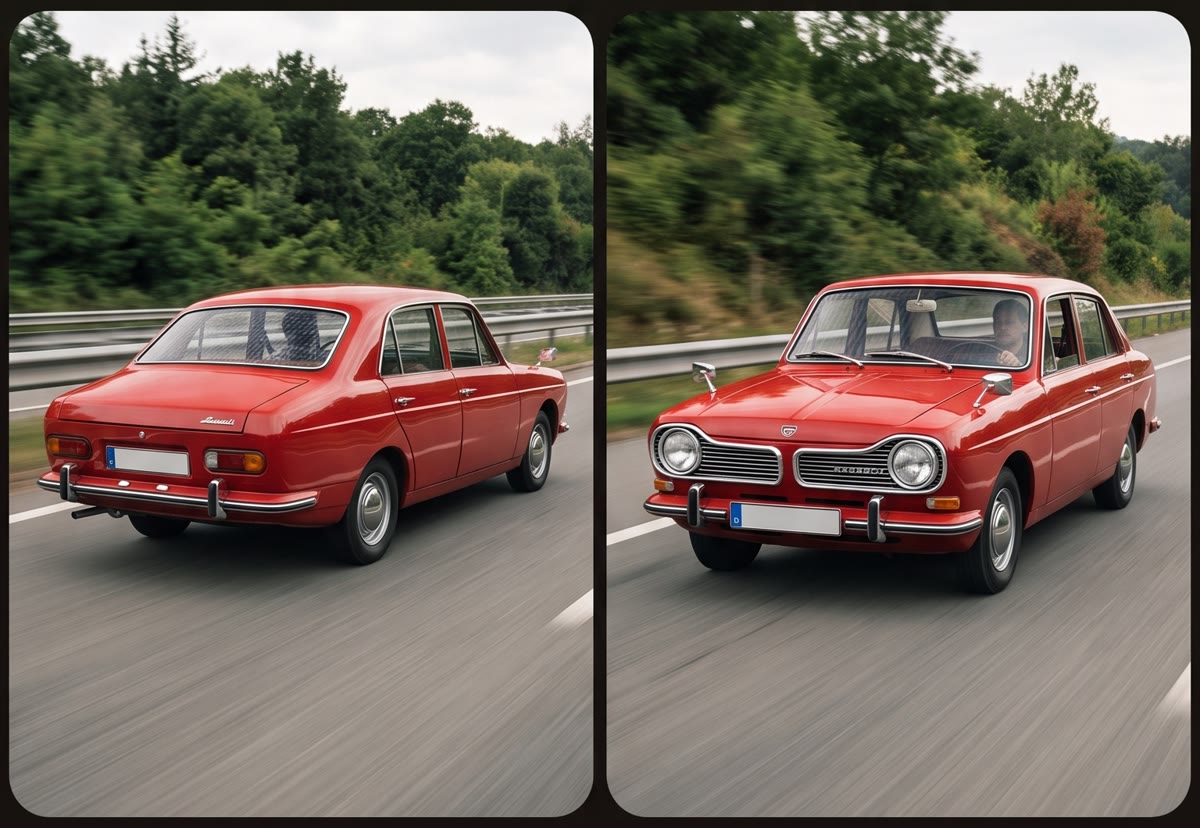
Önce aracın fotoğrafı
Aracınızın önden ve arkadan fotoğrafını çekin. Ben ikisini tek karede birleştirdim. Siz isterseniz ayrı ayrı yükleyin, isterseniz tek seferde verin. Model aracın tasarımını, rengini ve jantlarını bu fotoğraflardan alıyor.
1. yol Seedance 2.5 ile birebir aynısı
Birebir aynısını istiyorsanız Seedance 2.5 modelini kullanmanız gerekiyor. Ben Syntx AI'da ürettim, ama bu modeli sunan başka bir platformda da yapabilirsiniz.
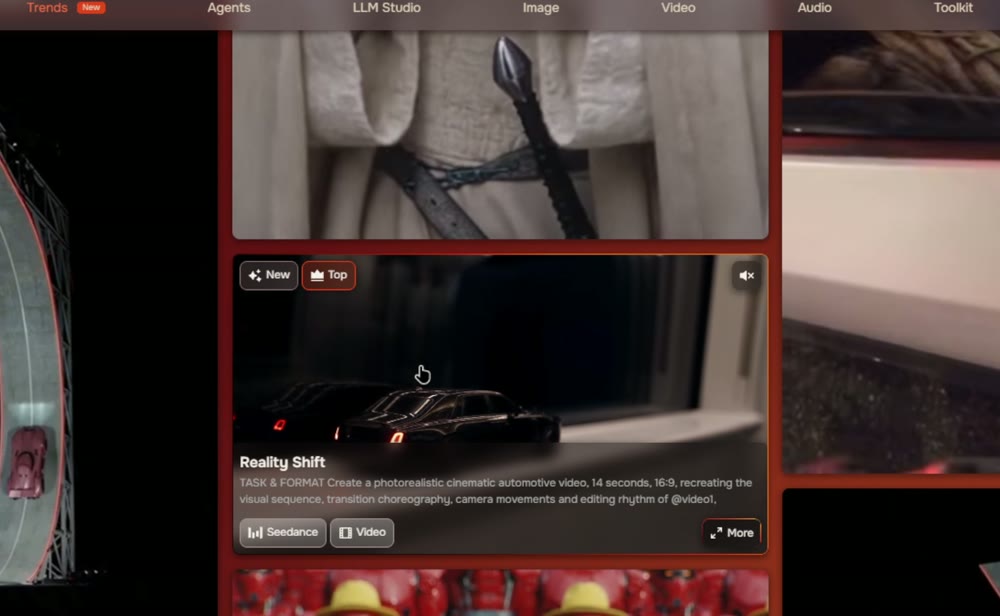
Trend videolar bölümünde Reality Shift'i bulun
Syntx AI'da üstteki Trends bölümüne girin, Reality Shift şablonunu bulup More'a basın.
Use this template deyin
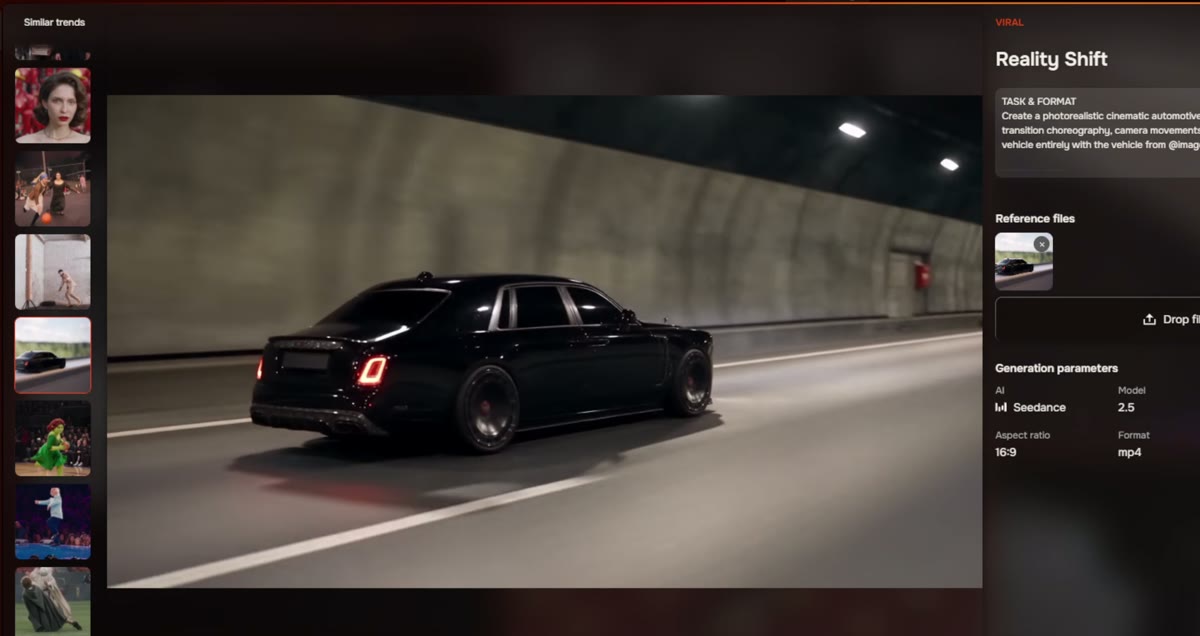
Şablon sayfasında sağ alttaki Use this template'e basın. Referans video ve prompt otomatik olarak geliyor.
Aracınızın fotoğrafını ekleyip üretin
Prompt kutusuna aracınızın fotoğrafını ekleyin ve üretin. Kullandığım ayarlar:
Seedance 2.5Omni Reference16:914 snSes açık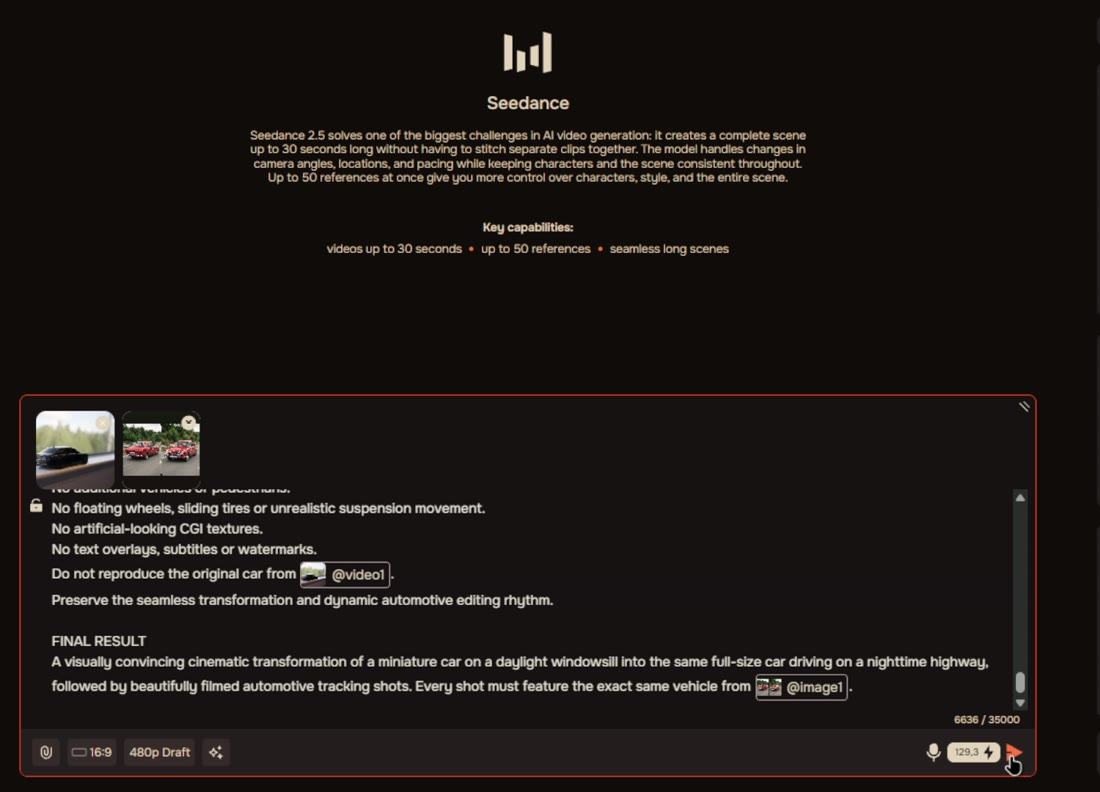
Referans video
Başka bir platformda yapacaksanız bu videoyu indirin ve @video1 olarak yükleyin. Aracınızın fotoğrafı @image1 olacak. Kamera hareketi, geçiş ve kurgu bu videodan geliyor.
14 sn · 7 MB · sesli. Telefonda indirme açılmazsa videoya basılı tutup kaydedin.
Seedance 2.5 prompt'uSyntx'te şablonla otomatik geliyor. Başka platformda yukarıdaki referans videoyu @video1, araç fotoğrafını @image1 olarak ekleyin.
TASK & FORMAT
Create a photorealistic cinematic automotive video, 14 seconds, 16:9, recreating the visual sequence, transition choreography, camera movements and editing rhythm of @video1, replacing the original vehicle entirely with the vehicle from @image1.

REFERENCES
@video1 = motion, camera, scene progression, environmental transformation, transition timing and edit structure only. Do NOT copy the original vehicle's identity, body shape, modifications or color.
@image1 = exclusive vehicle identity reference. Preserve the exact vehicle design, body proportions, paint color, grille, lights, wheel design, windows and all distinctive exterior details. The same vehicle must appear consistently throughout the entire video.

VISUAL STYLE
Ultra-photorealistic cinematic automotive footage. Natural optical depth of field, realistic motion blur, cinematic exposure, physically accurate reflections and materials. Premium nighttime automotive videography. No CGI appearance or cartoon styling.

TIMELINE

0.0–2.5s — MINIATURE ON THE WINDOWSILL
A perfectly detailed miniature-scale version of the vehicle from @image1 rests on a white indoor windowsill. Camera views the vehicle from a low rear three-quarter angle, matching @video1. A bright daytime landscape with green trees and a pale sky is visible outside. Shallow depth of field, realistic macro photography. The miniature looks like a precise physical replica of the actual vehicle, including its original body proportions and wheels.

2.5–5.5s — ENVIRONMENTAL TRANSFORMATION
Without any camera cut, the bright landscape outside the window gradually darkens and transforms into the interior of a nighttime road tunnel. Trees and sky disappear into darkness, followed by concrete tunnel walls, red roadside lights and overhead tunnel lamps. The vehicle's rear lights illuminate naturally. The white windowsill progressively starts visually aligning with the road surface. Preserve the camera angle, vehicle orientation and visual continuity. The transformation should feel like one impossible but completely seamless practical cinematic illusion.

5.5–7.0s — MINIATURE BECOMES REAL
The vehicle begins rolling forward. As the camera follows, the windowsill seamlessly becomes a full-size asphalt roadway and the miniature becomes the actual full-scale vehicle from @image1. Achieve the illusion through environmental transformation, continuous camera perspective and matching vehicle motion, rather than stretching, melting or visibly morphing the car. The transition must remain completely smooth. The white window frame disappears outside the moving camera composition, leaving a realistic road tunnel.

7.0–9.3s — NIGHT TUNNEL DRIVE
The now full-size vehicle drives quickly through the illuminated tunnel. A low rear three-quarter tracking camera follows alongside it, maintaining the original viewing direction. Tunnel walls, lane markings, lamps and roadside details move past naturally with convincing parallax and realistic speed. Wheels rotate correctly, suspension responds subtly to the road, and red taillights reflect on the pavement. The vehicle exits the tunnel onto a dark elevated road with metal guardrails and streetlights.

9.3–10.2s — FRONT DETAIL
A sharp cinematic cut to a low front three-quarter close-up. The vehicle drives toward and alongside the moving camera, headlights illuminating the asphalt. Accurately preserve the original front fascia, headlights and grille from @image1.

10.2–10.9s — REAR TRACKING
Cut to a dynamic low rear three-quarter tracking shot. The road surface blurs underneath, with natural taillight reflections and passing roadside barriers.

10.9–12.2s — HERO SHOT
Cut to a wider low front three-quarter automotive beauty shot. The full vehicle is visible driving along the empty illuminated highway at night. Realistic camera tracking, fast passing asphalt, subtle body vibration, natural reflections and strong visual presence.

12.2–13.3s — WHEEL DETAIL
Cut to an extremely low, tight side tracking shot focused on the front wheel. The wheel from @image1 rotates naturally with realistic rolling motion blur. Keep its exact rim design and tire proportions. The street surface rushes underneath.

13.3–14.2s — FINAL REAR SHOT
Cut to a centered low rear follow shot. The vehicle drives away along a straight, empty nighttime highway. Bright red taillights reflect on the asphalt. Streetlights and guardrails converge toward the distant vanishing point. End while the vehicle is still driving away.

CAMERA
Preserve the camera choreography and cut rhythm of @video1. The initial windowsill-to-highway transformation must be one uninterrupted continuous shot. After the transformation, use smooth professional low-angle vehicle tracking shots with natural perspective, realistic lens behavior and controlled handheld micro-movement. No random extra cuts or unrelated camera angles.

CONTINUITY & PHYSICS
Vehicle identity lock: @image1 determines the entire vehicle appearance from the first miniature frame to the last full-size highway frame.
Keep identical body geometry, color, trim, lights, wheel design and exterior features.
Do not invent spoilers, body kits, decals or other modifications absent from @image1.
The change in scale is achieved through cinematic spatial perspective and environmental transition, with no visible vehicle deformation.
Maintain correct wheel rotation, natural road contact, physically plausible motion and accurate reflections.
Maintain continuity of lighting and driving direction between shots.

AUDIO
Minimal realistic automotive sound design. A subtle engine start and brief acceleration synchronized with the vehicle beginning to move at approximately 5.5 seconds. Controlled engine and tire sounds during the driving sequence. Short natural tire and air movement details accompanying close tracking shots. No exaggerated impacts, bubbling, gurgling or unrelated ambient noise. No dialogue or added music.

CONSTRAINTS
No change of vehicle identity.
No vehicle body morphing or deformation.
No additional vehicles or pedestrians.
No floating wheels, sliding tires or unrealistic suspension movement.
No artificial-looking CGI textures.
No text overlays, subtitles or watermarks.
Do not reproduce the original car from @video1.
Preserve the seamless transformation and dynamic automotive editing rhythm.

FINAL RESULT
A visually convincing cinematic transformation of a miniature car on a daylight windowsill into the same full-size car driving on a nighttime highway, followed by beautifully filmed automotive tracking shots. Every shot must feature the exact same vehicle from @image1.
2. yol Google Flow ile ücretsiz
Birebir aynısı olmuyor ama aynı mantıkla çalışıyor. Video referans yok, sahneyi prompt anlatıyor: oyuncak araba trenin penceresinde, tünelde gerçek arabaya dönüşüp köprüye çıkıyor.
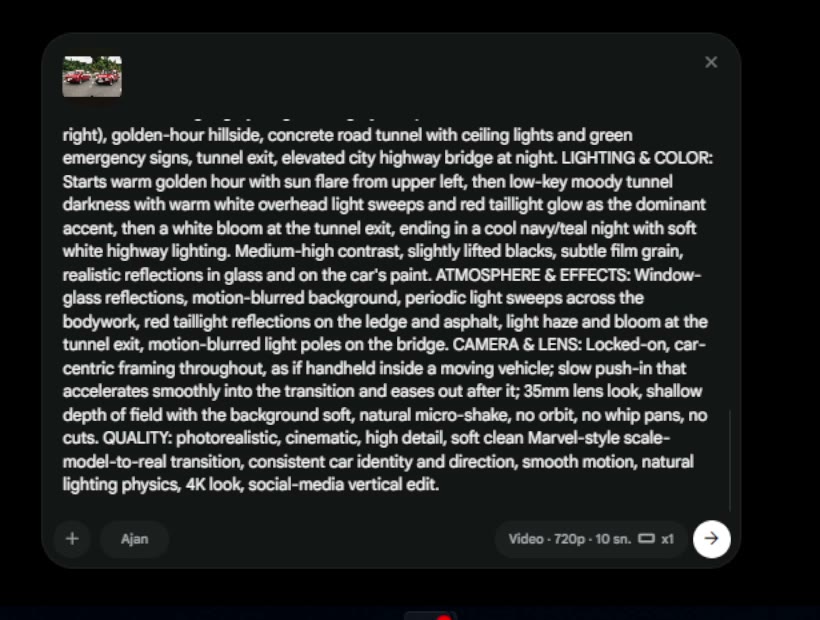
Fotoğrafı yükleyin, prompt'u yapıştırın
Google Flow'da yeni bir proje açın, aracınızın fotoğrafını prompt kutusuna ekleyin ve aşağıdaki prompt'u yapıştırın.
Video ayarlarını seçip üretin
Ayarlardan Video'yu seçin, süreyi 10 sn yapın ve gönderin.
Video16:9Omni 1.1 Flash720p10 snx1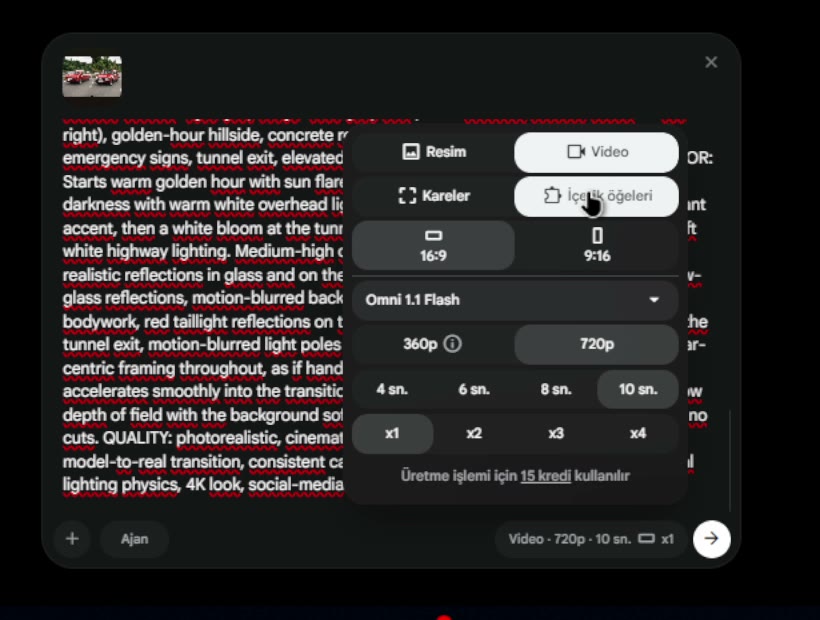
Google Flow prompt'uFotoğraftaki araç, oyuncaktan gerçeğe aynı kalıyor
IDENTITY LOCK: Use the exact car from the reference image as the hero vehicle. Preserve its make, model, body shape, paint color and finish, wheels, headlights, grille, badges and all design details exactly. Do not alter, redesign or replace the car. In the first half the same car appears as a perfectly detailed miniature scale model of itself; in the second half it is the full-size real car — identical design in both. DIRECTION LOCK: Regardless of which way the car faces in the reference image, in this video the car always faces and travels toward frame right: rear three-quarter view, rear bumper and taillights toward frame left, nose pointing to frame right, right-hand side of the car facing camera. Re-orient the car to this direction while keeping its design identical. It never faces left, never turns around and never reverses direction; when it drives, it moves from left to right only. FORMAT: 12 seconds, vertical 9:16, 30 fps, one continuous unbroken shot with no cuts. The car stays in the same position in frame the entire time: slightly left of horizontal center, in the lower-middle of the frame. The camera sits at roughly bumper/beltline height, very slightly above. Camera zoom: a very slow push-in from 0 to 6s, then a smooth, gradually accelerating push-in toward the car from 6s into the transition, reaching its closest framing at about 8.5s (car about 65% of the frame width), then easing gently back out to about 60% as the car drives onto the bridge. SHOT LIST (one continuous take): Shot 1 (0–1.2s): Inside a moving train. A miniature scale model of the car from the reference image sits still on the light grey window ledge. Through the glass, a wooded green hillside and concrete structures blur past from right to left. Golden-hour sun low in the upper left, warm hazy sky, warm rim light along the car's roofline. Shot 2 (1.2–2.0s): The train enters a tunnel: a concrete tunnel portal with yellow-black chevron warning signs sweeps past the window, and the light drops rapidly from warm daylight to darkness. Shot 3 (2.0–6.0s): Inside the dark tunnel. Tunnel ceiling lights and long horizontal light strips streak past outside the window from right to left, periodically sweeping highlights across the car's roof, glass and body. Green emergency exit signs pass in the background. Around 3.7–4.3s the miniature car's taillights fade on by themselves, casting a soft red glow onto the window ledge and reflecting in the window glass. The car remains perfectly still on the ledge. From 6s the camera begins a smooth, gradually accelerating zoom in toward the car, building anticipation for the transition. Shot 4 (8.0–9.0s): Soft, clean, Marvel-style cinematic VFX transition without any cut. As the camera's push-in reaches its closest point, the window glass and window frame gently dissolve into a fine, soft shimmer of light that drifts away, the window ledge flows smoothly into a road lane, and the train's interior wall panel melts seamlessly into dark asphalt. At the same moment the miniature scales up elegantly into the full-size real car, already driving forward toward frame right through the tunnel. The motion is fluid and polished, like a high-end superhero film transformation: no glitch, no flicker, no distortion of the car. The camera then eases slightly back and becomes a parallel tracking camera moving at the same speed as the car. Red taillight reflections on the asphalt, pale tunnel wall and green exit signs behind. Shot 5 (9.0–10.1s): The car approaches the tunnel exit. A bright white light bloom and light haze flood in from frame right, the tunnel arch and light poles flash past, the car briefly turns into a soft silhouette against the glow. Shot 6 (6–10.0s): The car emerges onto an elevated highway bridge at night and keeps cruising from left to right. Deep navy night sky fills the upper half of the frame; a metal guardrail and distant city skyline lights sit low on the horizon; white dashed lane markings and tall street-light poles whip past with motion blur. Slight handheld vehicle-mounted shake. The shot ends mid-motion. ENVIRONMENT: Train window interior (light grey ledge, dark grey wall panel, rounded window frame on the right), golden-hour hillside, concrete road tunnel with ceiling lights and green emergency signs, tunnel exit, elevated city highway bridge at night. LIGHTING & COLOR: Starts warm golden hour with sun flare from upper left, then low-key moody tunnel darkness with warm white overhead light sweeps and red taillight glow as the dominant accent, then a white bloom at the tunnel exit, ending in a cool navy/teal night with soft white highway lighting. Medium-high contrast, slightly lifted blacks, subtle film grain, realistic reflections in glass and on the car's paint. ATMOSPHERE & EFFECTS: Window-glass reflections, motion-blurred background, periodic light sweeps across the bodywork, red taillight reflections on the ledge and asphalt, light haze and bloom at the tunnel exit, motion-blurred light poles on the bridge. CAMERA & LENS: Locked-on, car-centric framing throughout, as if handheld inside a moving vehicle; slow push-in that accelerates smoothly into the transition and eases out after it; 35mm lens look, shallow depth of field with the background soft, natural micro-shake, no orbit, no whip pans, no cuts. QUALITY: photorealistic, cinematic, high detail, soft clean Marvel-style scale-model-to-real transition, consistent car identity and direction, smooth motion, natural lighting physics, 4K look, social-media vertical edit.
İpuçları
Denemek için kaydedin, işinize yaradıysa Instagram'da takip etmeyi unutmayın.